
Enterprise AI Measurement Guide
Agent Effectiveness
Agent Effectiveness Score
What seven dimensions make up the Agent Effectiveness Score breakdown, and what does the score show about AI coding agent use?
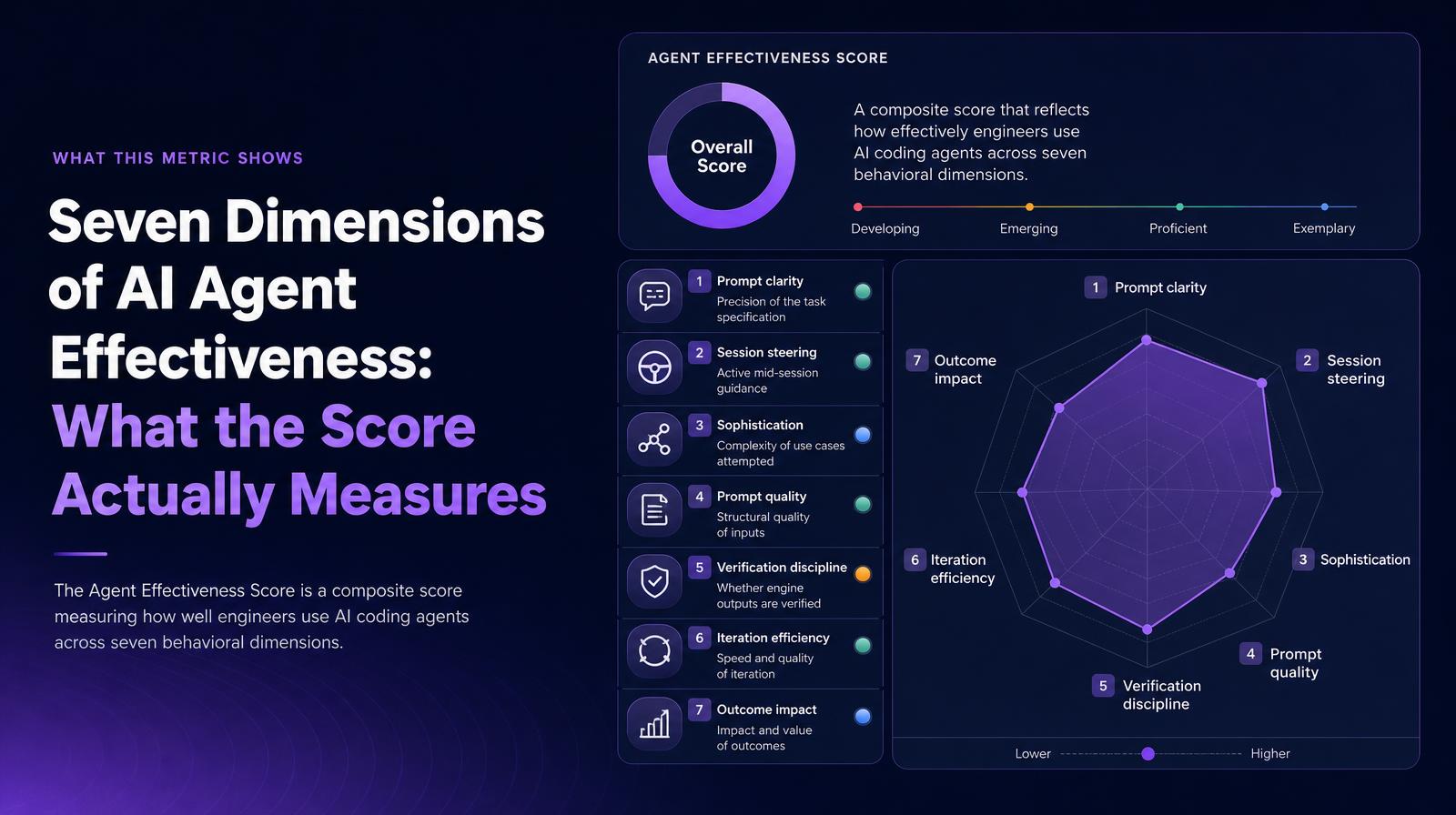
What it shows
The Agent Effectiveness Score is a composite score measuring how well engineers use AI coding agents across seven behavioral dimensions: Prompt clarity (precision of the task specification), Session steering (active mid-session guidance), Sophistication (complexity of use cases attempted), Prompt quality (structural quality of inputs), Verification discipline (whether engineers verify agent output before accepting), Task outcomes (whether sessions produce merged PRs), and User sentiment (engineer-reported experience). The score distinguishes engineer proficiency from agent capability, a high score with a low Outcome Success rate points to a workflow design problem, not a tool problem.
Why it matters
Most AI coding tool evaluations focus on what the agent can do. The Agent Effectiveness Score measures what engineers actually do with the agent, a fundamentally different question that produces fundamentally different interventions. An org whose score is held down by low Verification discipline needs training investment; one held down by low Sophistication needs enablement and use-case expansion programs. The seven-dimension breakdown converts a single score into a targeted development roadmap.
The Larridin angle
Larridin is the only enterprise AI measurement platform that scores engineer behavior with agents independently of agent capability, making it possible to improve ROI from existing tools through training and workflow design, rather than defaulting to purchasing a more expensive tool whenever productivity targets aren't met.
Related Agent Effectiveness Metrics
Common questions
What does the Agent Effectiveness Score measure?
The Agent Effectiveness Score measures how well engineers use AI coding agents across seven dimensions, including prompt clarity, session steering, and task outcomes.
How does the Agent Effectiveness Score differ from other AI tool evaluations?
Unlike other evaluations that focus on agent capabilities, the Agent Effectiveness Score assesses engineer behavior with the agent, highlighting areas for targeted development.
Why is the seven-dimension breakdown important for organizations?
The breakdown helps organizations identify specific areas like verification discipline or sophistication that need improvement, guiding targeted training and development efforts.
How can the Agent Effectiveness Score impact ROI on AI tools?
By focusing on improving engineer behavior rather than upgrading tools, organizations can enhance ROI through better training and workflow design.