
Enterprise AI Measurement Guide
Agent Effectiveness
Session Depth
What is the average number of prompts or turns per AI coding agent session in the selected period?
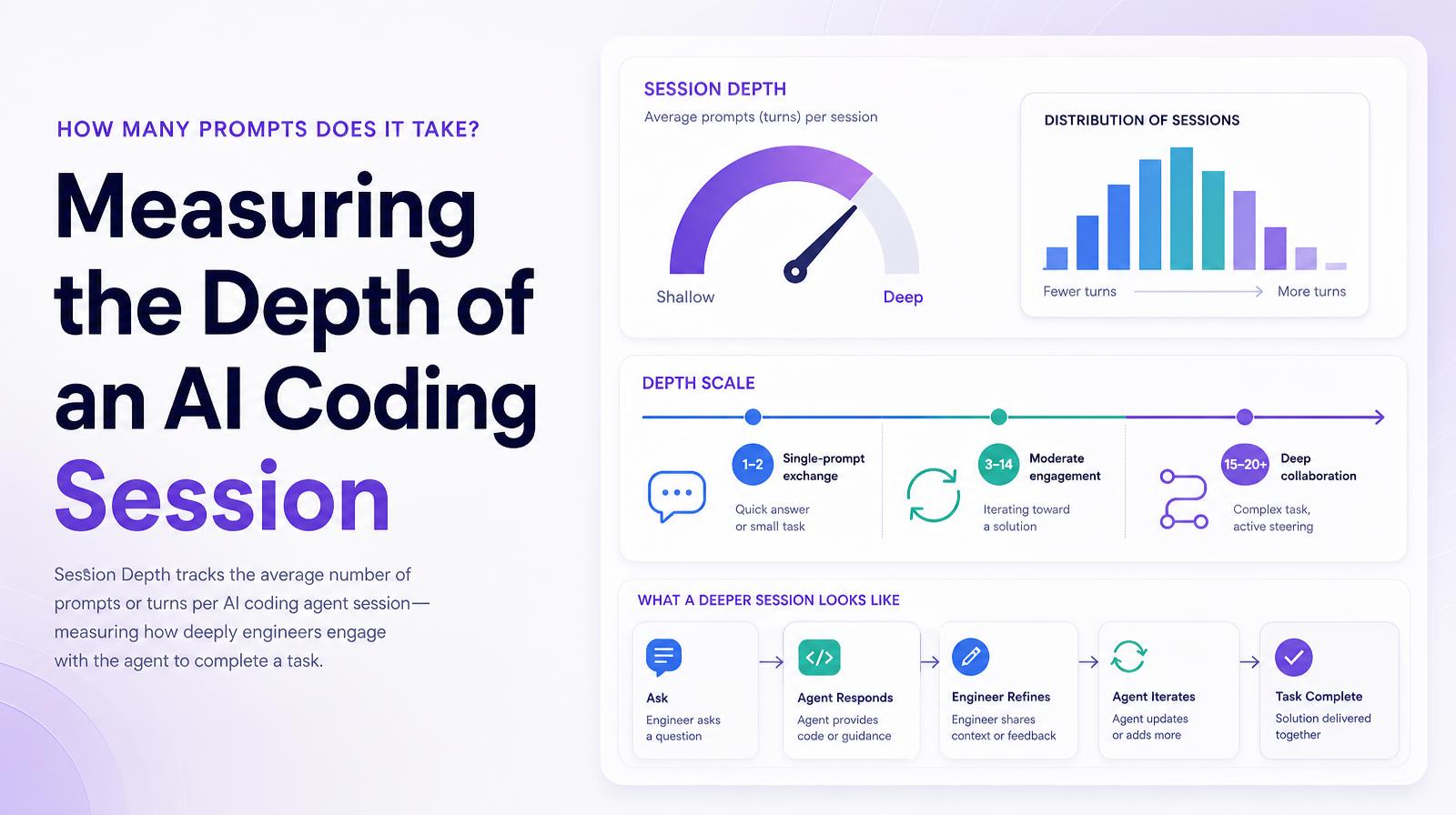
What it shows
Session Depth tracks the average number of prompts or turns per AI coding agent session, measuring how deeply engineers engage with the agent to complete a task. A session with 1-2 turns is a single-prompt exchange; a session with 15-20 turns represents extended back-and-forth where the engineer is actively steering the agent through a complex task. Session Depth is both a proficiency signal and a cost signal, since longer sessions accumulate more tokens through context accumulation across turns.
Why it matters
Very shallow sessions may indicate engineers are using agents for simple, single-step tasks, which limits the leverage available. Very deep sessions without corresponding Outcome Success may indicate the engineer is struggling to steer the agent toward a useful result, or that the agent is looping, a training gap or a tool limitation, both requiring different interventions. Session Depth is the behavioral diagnostic that distinguishes productive deep engagement from expensive unproductive loops, and it directly determines token accumulation cost in agentic architectures.
The Larridin angle
High Session Depth alongside low Outcome Success is the signature of expensive, unproductive looping, sessions that consume many tokens and many turns without producing a merged PR. Larridin's Token Spend & Insights layer surfaces the cost implication of that pattern: a 20-turn session that produces no output costs roughly 10-15x more in token consumption than a 2-turn session, with zero output to show for the difference.
Related Agent Effectiveness Metrics
Common questions
What does Session Depth measure in an AI coding session?
Session Depth measures the average number of prompts or turns per session, indicating the level of engagement engineers have with the AI coding agent to complete tasks.
Why is Session Depth important for the C-suite?
Session Depth helps identify whether engineers are using AI agents effectively, distinguishing between productive deep engagement and costly unproductive loops, which impact token costs and task outcomes.
How can high Session Depth with low Outcome Success affect an organization?
High Session Depth with low Outcome Success suggests unproductive looping, leading to increased token consumption without producing valuable results, thus escalating operational costs.
How does Session Depth relate to token costs in AI coding sessions?
Longer Session Depth accumulates more tokens as context builds across turns, making it a direct indicator of token consumption costs in AI coding sessions.